It is worth noting that it may take a few sessions to build up the rapport and trust necessary for therapy to work.

Counselling for OCD provides structured guidance to help you understand your thought processes, feelings, and behaviors related to your symptoms.
Counselling offers a safe space to challenge obsessive thoughts and resist compulsive behaviors, and learn practical skills on how to cope, manage, and reduce ocd symptoms. Early intervention can prevent OCD symptoms from worsening. Getting support can also reduce feelings of guilt, shame, or isolation.
Therapy using gradual exposure helps to free you from your compulsions by helping you build tolerance and become less sensitive to them. Evidence-based therapy like Cognitive Behavioral Therapy (CBT), can be highly effective in helping individuals manage OCD, While mindfulness techniques can help individuals observe and detach from obsessive thoughts.
OCD is characterized by recurrent, persistent, intrusive thoughts (obsessions), and repetitive behaviors or mental acts (compulsions) aimed at reducing anxiety or finding relief from these unrelenting obsessive thoughts.
The signs and symptoms are typically distressing, time consuming and significantly interfere with a person’s normal routine, work, or social activities and relationships.
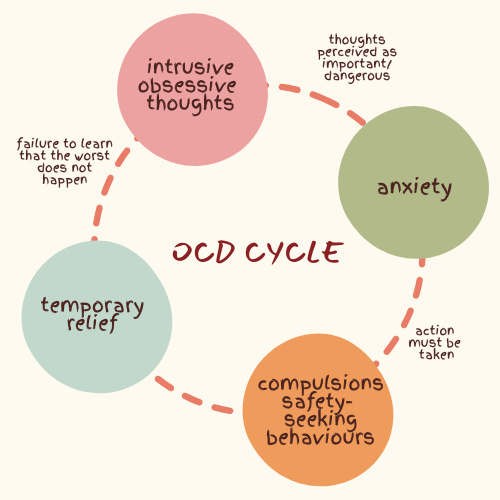
Some Key ideas of ocd
thought-action fusion;
the idea that having a ‘bad’ thought can result in ‘bad’ consequences, or that having a thought about something ‘bad’ is morally just as bad as carrying out a bad action.
inflated responsibility;
assuming that one has the power and obligation to prevent bad things from happening.
intolerance of uncertainty;
a belief that things must and can be certain
overestimation of threat
_
example; infection from dirty surfaces
leads to washing or cleaning rituals
_
example; electric switches or door locks
leads to checking and/or repeating rituals
_
leads to repeated actions until things are ‘just right’
_
example;
sexual or aggressive behavious
leads to unhelpful attempts to control thoughts
_
excessive cleaning, checking & repeating actions such as counting or tapping
_
Neutralising ‘bad’ thoughts by thinking other ‘good’ thoughts
suppression of thoughts
_
avoidance of situations, people or objects that trigger the obsessional worries
_
from friends, family, doctors, or others
The causes of OCD are currently unknown but likely involve a combination of factors including imbalances in brain chemistry, genetic, experienced trauma, and other life stressors.
The duration of counselling for OCD can vary depending on individual needs and circumstances. Some clients may achieve significant progress in a few sessions, while others may require more time. The counsellor will assess your situation during the initial consultation and discuss a recommended timeframe for your journey.
Regular sessions are typically scheduled, allowing for ongoing support and monitoring of progress.
It is worth noting that it may take a few sessions to build up the rapport and trust necessary for therapy to work.
The self-assessment tool provided for evaluating OCD can offer insights into your experiences and symptoms, but they are intended for informational purposes only and are not a substitute for professional medical or psychological advice, diagnosis, or treatment.
If you are experiencing significant distress, mental health challenges, or have concerns about your well-being, please seek guidance from a qualified mental health professional.
It is recommended that you complete them in a safe and supportive environment.
Your mental health is important.


if you or anyone you know are in need of immediate help
Samaritans of SingaporeInstitute of Mental HealthGentle Mind Counselling & Psychotherapy
Hello & Thank You For Contacting Gentle Mind Counselling.
Feel free to contact us to book a counselling session, request a free 20-minute consultation, or ask about our services.
Once we have received your message, we will respond as soon as we are available.
Please be assured that your privacy is our priority, and all communications are handled with care and confidentiality.
Chat on WhatsApp
🟢 Privacy policy